Primordial Light: DEEP SKY Page 2
Gray Line
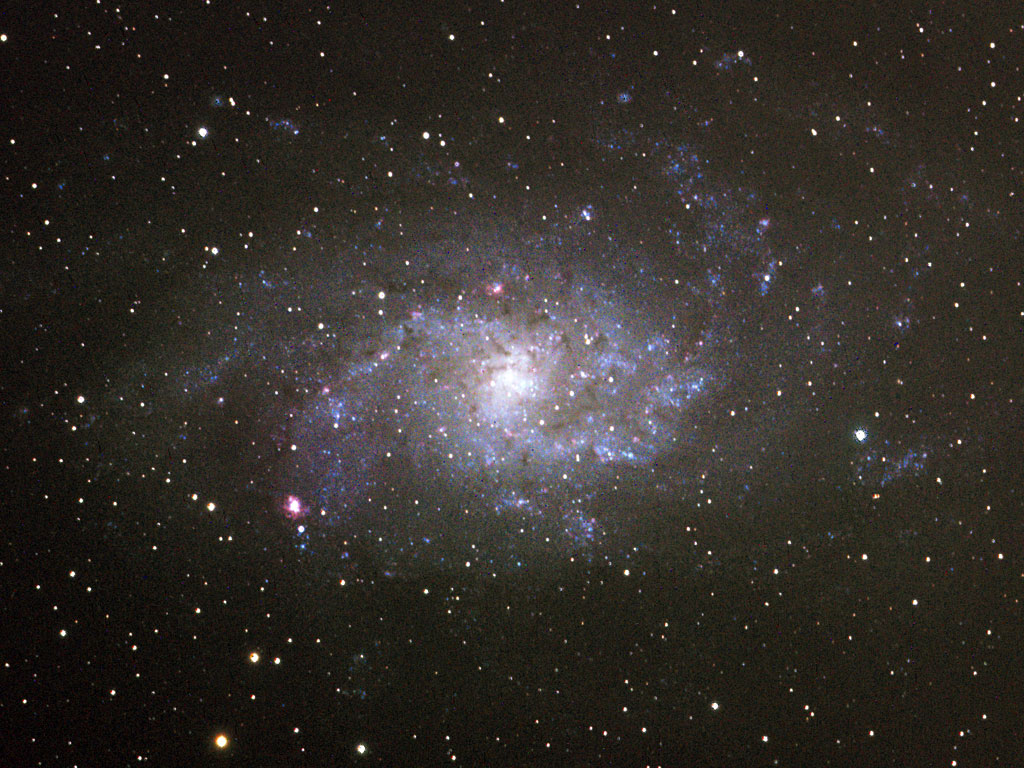
M33, The Triangulum Galaxy
M33

September 27, 2009. M33 is a face-on spiral galaxy about 3 million light years (LY) from Earth (very near in cosmic terms) in the undistinguished constellation Triangulum. It is a member of the Local Group, which is a cluster of galaxies, including our own Milky Way, that are close enough to each other to be gravitationally bound together. The largest member of the Local Group is M31, the Andromeda Galaxy (no photo here, yet). Our galaxy, the Milky Way, is the second largest, and M33 is the third largest. M33 is about 50,000 LY across, which is about half the size of the Milky Way, and it contains perhaps 50 billion stars, compared to about 400 billion in the Milky Way. M33 is rather diffuse and has low surface brightness and it does not seem to photograph well through polluted skies (like mine). All stars that are seen overlaying the galaxy are nearby stars in the Milky Way. Only the largest telescopes are able to resolve individual stars in distant galaxies. The blue haze is the cumulative light of the billions of unresolved stars and the brownish smudges are vast dust clouds that are the birthplaces of new stars. LRGB with an SBIG STL-11000M on a Takahashi TOA-150. Made on a Mac with Nebulosity, PixInsight, and Photoshop CS3.

Gray Line
M13 and NGC 6207
M13

June 20, 2009. M13 is a globular star cluster in the constellation Hercules. It is about 25,000 light years from Earth and it contains several hundred thousand stars. Because it is a relatively compact object the star density at the cluster’s core is hundreds of times greater than in the vicinity of our Solar System. That means that you would see a lot of stars in the sky when you looked up at night—or maybe even the daytime—if you lived on a planet near the center of M13. The object at the lower left of the photograph is the spiral galaxy NGC 6207.

NGC 6207 is thought to have been discovered by William Herschel (Friedrich Wilhelm Herschel) in 1787, but it is a quite ordinary galaxy and it was not an object of study until a star exploded in the galaxy in 2004. This was a Type II supernova designated SN 2004A.

There is a magnitude 7 foreground star (GSC 2588:1971) in the line of sight to the core of the galaxy; some have mistaken the star for a bright galactic core, but it is not; the core of NGC 7207 is undistinguished.

The red star at bottom is HIP 81848 and the white star at top right is HIP 81673. While both of these stars appear to be brighter than GSC 2588:1971, records available to me show that they are both dimmer than the former star. The dimmest stars in the photograph are of approximately magnitude 15.

The distance to NGC 6207 is not known with certainty, but astronomers studying SN 2004A estimated that it is from 68 to 91 million light years from Earth. That would mean that the photons that my camera captured to make this picture departed this galaxy when the dinosaurs still roamed the Earth.

This photo consists of six exposures of three minutes and 30-seconds each. The exposures were made during a rare period of clear weather (about 1-1/2 hours of it) in the midst of one of the cloudiest, wettest years in Maryland history. I used a modified Canon 40D and an Astronomik clip-in LPR filter on my Takahashi FSQ-106. The mount is an Astro-Physics 1200GTO and the exposures were unguided..

Gray Line
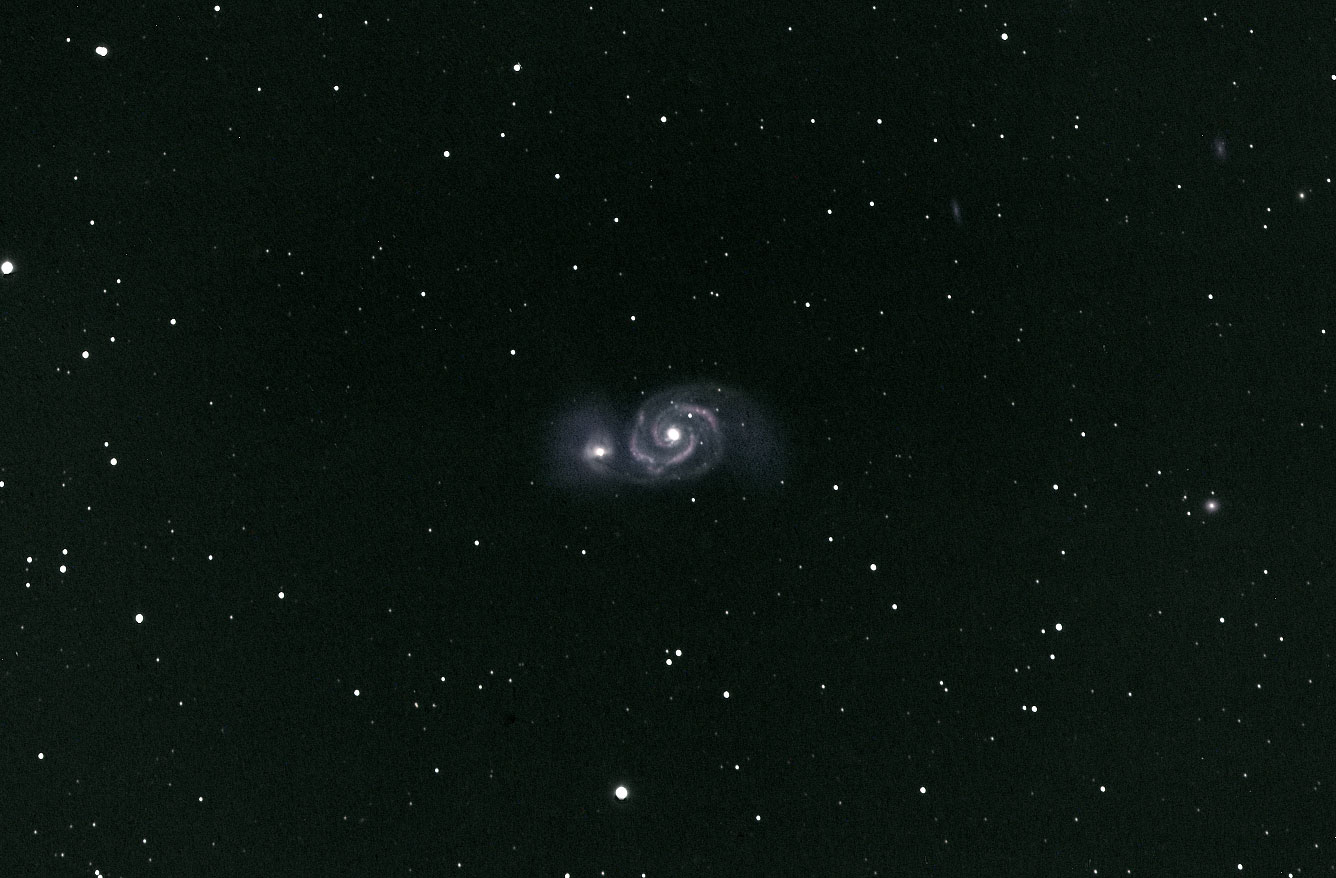
M51, the Pinwheel Galaxy, and Its Neighbors

April-May, 2008. The famous Pinwheel Galaxy in the northern constellation Canes Venatici. If you place your cursor over the image you will see the names of some of M51’s neighbors. M51 and its companion galaxy NGC 5195 are experiencing a close encounter of the gravitational kind. There appears to be a bridge of stars connecting the two galaxies. This would indicate that M51, with its greater mass, is disrupting NGC 5195 and stripping away its stars. Eventually the two galaxies will merge into a galaxy that will probably not resemble what we see today. The faint light surrounding with both galaxies is actually starlight from regions with a lower density of stars than the central parts of the galaxies. The number of stars in M51 and its companion, numbers in the hundreds of billions. The distance to M51 is believed to be about 30 million light years.

NGC 5198 is a giant elliptical galaxy that is about 150 million light years distant. It must be extremely luminous to appear as bright as it does at that great distance. IC 4263 and NGC 5169 are spiral galaxies.

Takahashi FSQ-106ED, SBIG STL-11000M. LRGB.

Gray Line
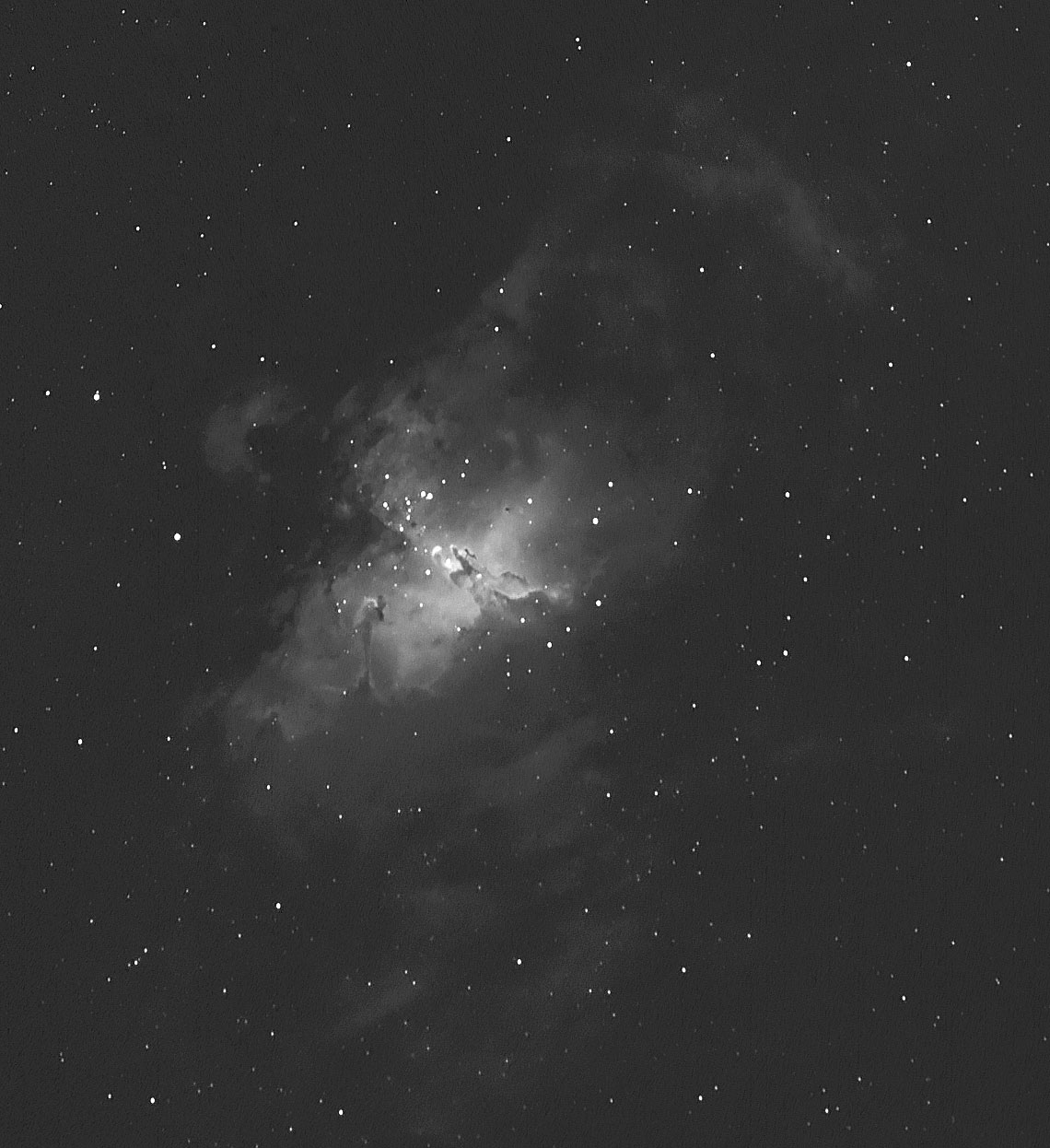
Wide View of M16, the Eagle Nebula

May 30, 2008. M16 (NGC 6611,) the Eagle Nebula

The Eagle Nebula was discovered by Jean Phillippe Loys de Cheseaux in 1845. The many columns of dust and gas in M16 have been nicknamed the “Pillars of Creation” because they are regions where new stars are forming. The black spots that stand out against the nebula in the background are also starbirth regions. They are called Bok Globules after the great astronomer Bart Bok. M16 is in our celestial back yard at a distance of only 7,000 light years. Takahashi FSQ-106ED, SBIG STL-11000M, Hydrogen Alpha.

Gray Line
More Deep Sky
1
3
4