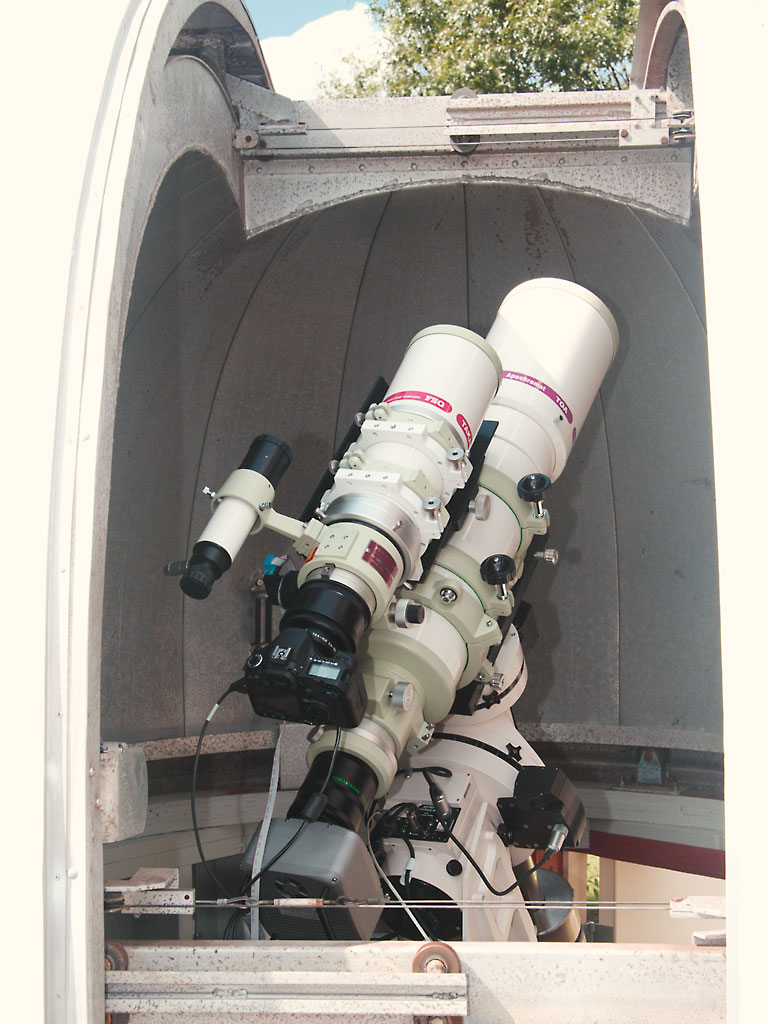
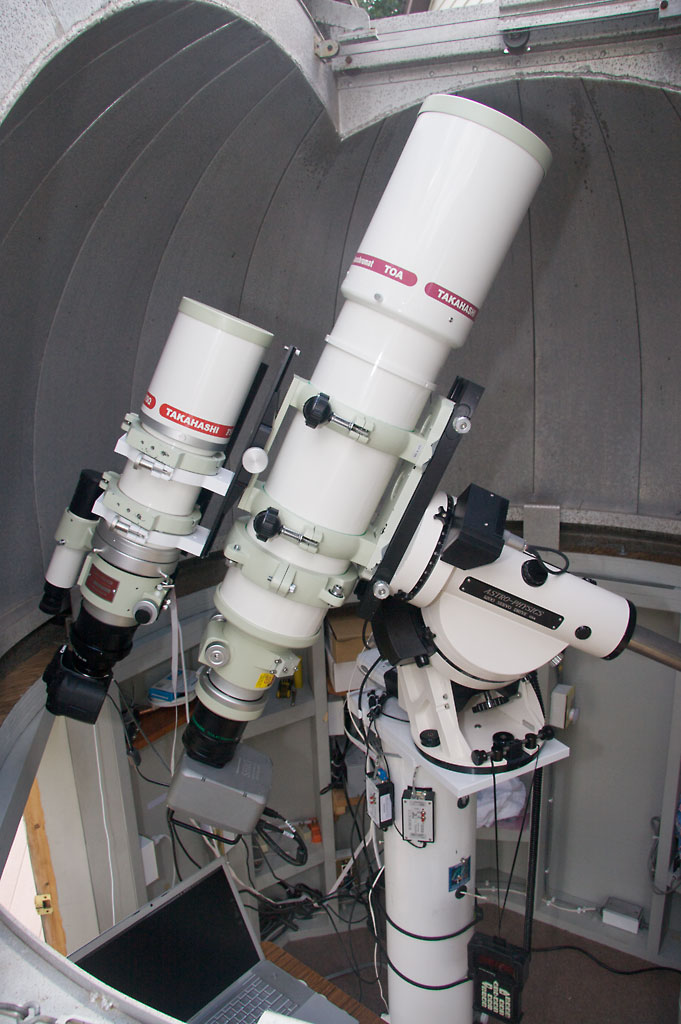
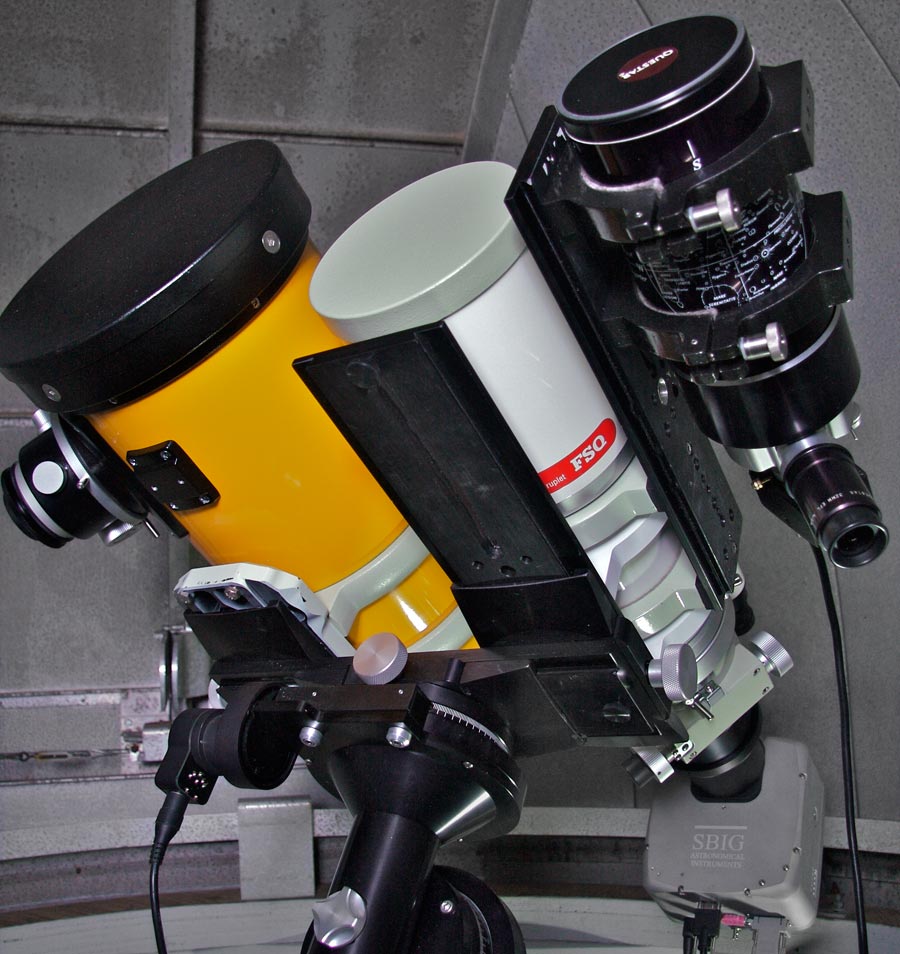
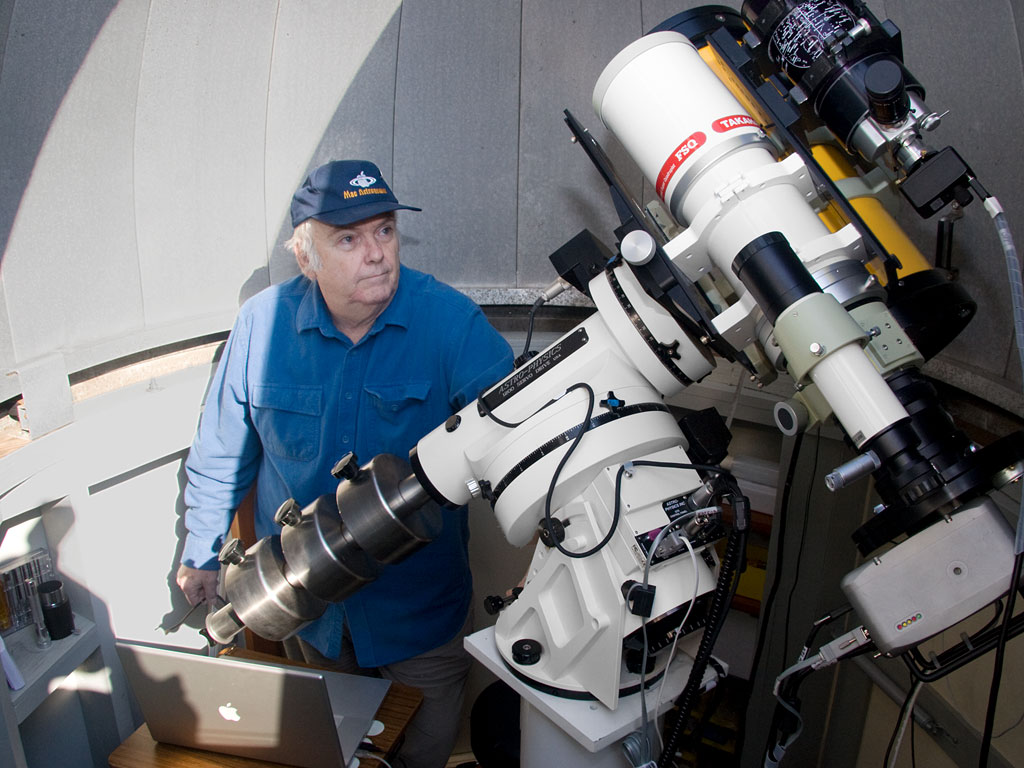
| This is the observatory as it was configured before I bought the TOA-150 (6-inch) refractor. The orange telescope is a Takahashi “Tak” Epsilon
180ED that I acquired in August, 2007. The small black telescope is my first
telescope, a 1982 Questar Duplex. The Epsilon has a focal length of 500mm and a focal ratio of 2.8. It is called a “fast astrograph.” Fast because its focal ratio of 2.8 is relatively fast, and astrograph because it is intended primarily for astrophotography and is
not ideally suited to visual observing. The white telescope is a different kind of astrograph; a 106mm ƒ 5 refractor—Tak FSQ-106 ED. At the back of the FSQ is a Finger Lakes Instrumentation (FLI) PDF temperature-compensated focuser and behind the focuser at the lower-right corner of the photo is my SBIG STL-11000M astronomical CCD
camera. The SBIG external guide camera is the small black box mounted on the Questar’s
axial port. There are other photos of the Questar at work here. Not visible are a Robofocus and a modified Canon 40D digital SLR that are mounted on the Epsilon. Everything is mounted
on an Astro-Physics 1200GTO
German Equatorial Mount. Previously all of this was mounted on a Losmandy G11 mount, as seen above. The Losmandy is an excellent mount with ample precision for astrophotography, but it is not rated to carry as much weight as it is carrying above. Note that it is all controlled from an Apple Macintosh MacBook Pro. My wife, Leona, made this photo for a three-page article about my use of Macs in amateur astrophotography that MacLife ran their February, 2009, issue. |