Primordial Light: DEEP TIME
The Universe is 6,000 years old, you say? America, we’ve got a problem.
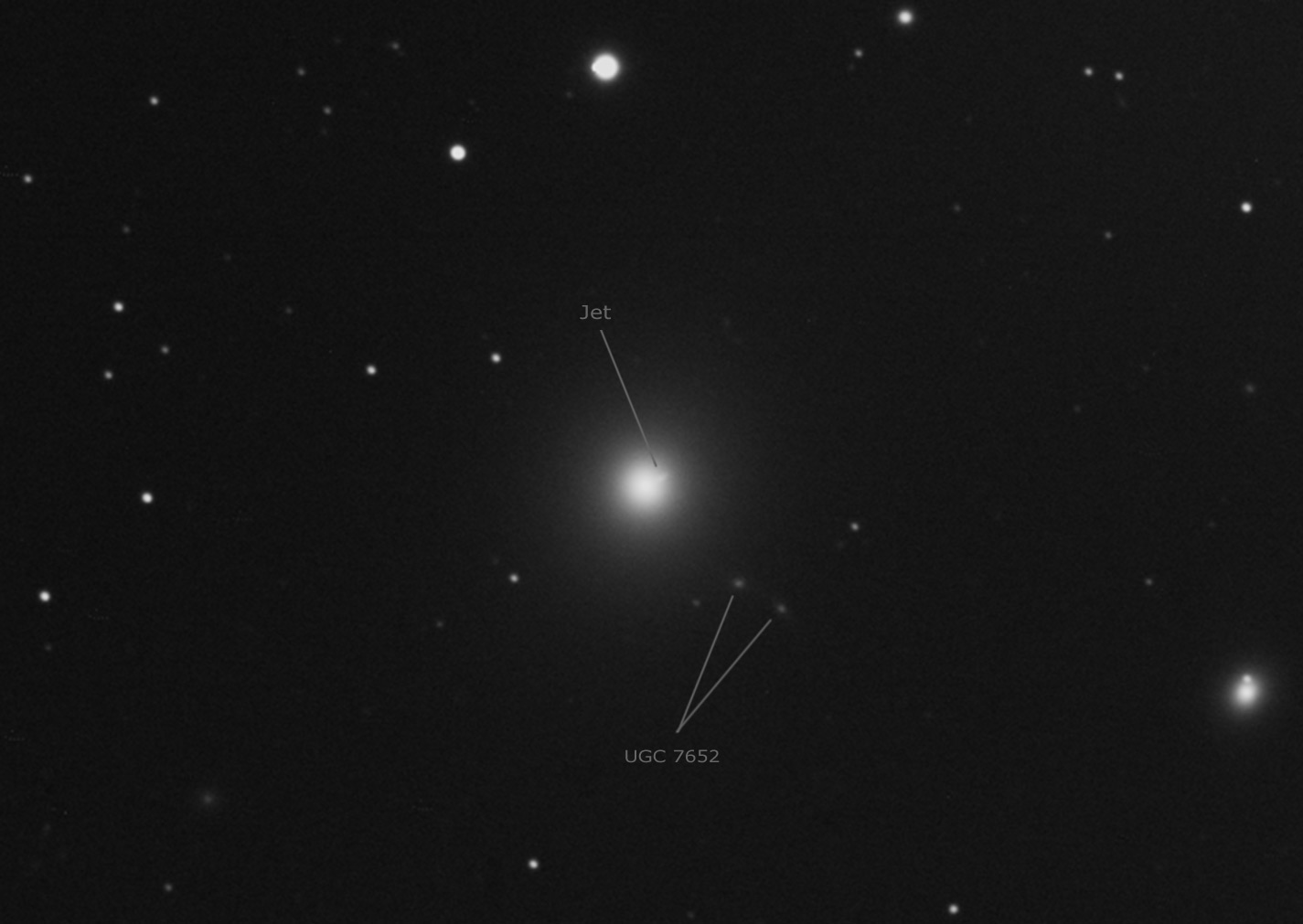
ngc2903
The light that made this photograph departed the
spiral galaxy NGC 2903 more than 20 million years ago.
We've got a problem because the age of the Universe is 13.73 billion years plus or minus 120 million years. This number is not a guess, but the result of remarkably precise measurements by the Wilkinson Microwave Anisotropy Probe team that are corroborated by data from the Hubble Space Telescope; the Cosmic Background Explorer; the Spitzer Space Telescope; the large ground-based telescopes, including the radio telescopes; and numerous discoveries in a variety of scientific disciplines spanning more than a thousand years. Deep Time—the realization that the Earth is ancient—and that the Universe is far more ancient—may be counted among the greatest of human intellectual achievements.

One of many ways that we know that the Universe is very old is the indisputable evidence in this photograph that there is nothing unusual about the galaxy we live in—it has billions of counterparts throughout the Universe. Our galaxy, the Milky Way, contains about 400 billion stars. This is not a guess, either, but a very reasonable estimate based upon sound science. We know the diameter of our galaxy (about 100,000 light years) and the orbital velocity of many stars, and to know those parameters is to know the mass of our galaxy. To know the mass is the key to making a reliable estimate of the number of stars in the galaxy because there are upper and lower constraints on the masses of stars. The number of bright galaxies in our Hubble Volume—that part of the Universe that we can see and explore with our instruments—is also about 100 billion. We don’t know the number of dim galaxies that we cannot see, but it must be vast. Some of the bright galaxies are larger than the Milky Way and some are smaller. It is reasonable to estimate that they have about 400 billion stars each. (Though the nearest large galaxy to us, the Andromeda Galaxy, or M31, is twice the diameter of the Milky Way and contains a trillion stars. It takes light about 2.5 million years to travel from M31 to our telescopes.)

The claim that the Universe is 6,000 years old is not simply inaccurate; it is so far off the mark as to be nonsensical. If the Universe were 6,000 years old, all the matter in the Universe—the 400 billion stars in our galaxy and the 400 billion stars in each of the 100 billion bright galaxies in our Hubble volume—would be contained in a sphere 6,000 light years in diameter. If that were true then the stars—including our sun—could be no larger than the smallest known subatomic particle. It would mean that we are wrong about the size of the Earth and everything on it. Since the sun has a volume of about 1.3 million Earths, the Earth would have to be at least 1.3 million times smaller than the smallest known subatomic particles. The claim is nonsensical because a 6,000-year-old universe would contain no stars, no planets, no people; it would be a Universal Black Hole. Our experience tells us that it is not.

If the Universe is 6,000 years old, everything we think we understand in science—everything—is wrong. We don’t know the speed of light. The theory of gravity is invalid (watch out for upward-falling apples!) We don't know about stars. Atoms don’t exist, so all of chemistry is wrong. Wheels don’t turn, rulers don’t measure distance, clocks don’t measure time, we have no understanding of mathematics. We can't generate electricity or develop a polio vaccine. We can’t even enumerate the fingers on our hands. Worst of all, perhaps, your cell phone doesn’t work.

In short, the Universe itself cannot exist if the Universe is 6,000 years old. If the Universe cannot exist if it is 6,000 years old, then—if we accept that the Universe exists—the Universe cannot be 6,000 years old.

The measured age of the Universe, 13.73 billion years plus or minus 120 million years, will not be refined to a great degree. At the beginning of 2008 the age was given as 13.7 billion years within a one percent margin of error. The refinement of some millions of years that was announced in March, 2008, reflected the continuing analysis of WMAP data. There is a limit to how far the measurement can be refined, however; the WMAP team is not going to announce that the Universe came into being at 3:18 p.m. on a fine Monday in May (but see Bishop Ussher below).
line
But the Bible says... The Bible doesn’t say anything at all about the age of the Universe. The age of the Universe was not measured by people whose purpose is to repudiate the Bible, but by people who seek to explain the truths behind known facts. Science should have nothing to say about the veracity of the Bible because the Bible is in the realm of the supernatural, and the supernatural presents no evidence to be tested and proved or disproved, while it is the place of science to explore the testable, the verifiable, and the falsifiable. To paraphrase Nature, the ancient age of the Universe isn't atheist theology. It is unassailable fact. Persons who believe that the Universe is young because they think the Bible says so probably ought to find a way to reconcile their misunderstanding with the truth that I have presented here, because the truth will not go away. More rational students of the Bible have known for a long time that the reputed historic events in the Bible are not to be taken literally, but that they reflect the obvious fact that nomadic herdsmen did not know very much about the world a few thousand years ago.

What is the age of the Earth?

In 1650, Bishop James Ussher, a scholar and an Anglican theologian, announced that the world was created on Sunday, October 23, 4004 BC. He based his conclusion on laborious calculation of the ages and reigns of kings in the Bible. Isaac Newton, one of the greatest scholars who ever lived, agreed with the Bishop. The Bishop and Newton were wrong.

Neither Ussher nor Newton was a geologist. James Hutton, however, was a geologist—the father of modern geology, in fact. Hutton was born in Edinburgh in 1726, less than a year after Newton's death. Hutton was fascinated by the geology of Britain, and it was his publication of The Theory of the Earth in 1787 that made him the father of modern geology. In a nutshell, here's what Hutton did. He realized that the presence of marine fossils high in mountain ranges meant that the rock from which those mountains were made had to have been ocean bottom at one time, and that geological forces had turned that ocean bottom into rock and pushed that rock upward until it became mountains, high above the oceans. He also recognized that mountains wear down due to erosion from water and wind, and the residue—sand—finds its way back to the ocean, where the process is repeated. Hutton knew that this process did not happen in a short time—certainly not as short at 6,000 years—because he had studied ancient maps and he knew that there had been no appreciable change in Britain's coastlines, rivers, or mountains in recorded history. Hutton's huge intellectual achievement marked the beginning of the discovery of Deep Time—the knowledge that the Earth is ancient. Hutton could not know how ancient, because knowledge of the decay rate of radioisotopes lay over a hundred years in the future. If Hutton and all the geologists who came afterward were wrong we would observe the appearance and disappearance of mountain ranges, canyons, rivers, lakes, and oceans in the duration of a human lifetime. Such a planet would be a dangerous, perhaps uninhabitable, place.

It seems I am getting into religion. Religion is outside the scope of this web site, which is mainly about my attempts to make pretty pictures of the night sky, but I'll offer this: The Bible contains history, prophecy, and wisdom. Heed the wisdom. Love your neighbor. Treat others the way you want to be treated. Forgive those who do you wrong. Be compassionate. Be just. There is enough in those few entreaties to keep you busy for a lifetime, during which you won't have time to worry about how much of the supposed history is myth or whether you will ever manage to understand the prophecy.
Our home galaxy, the Milky Way, is about 13 billion years old, which makes it a charter member of the Universe; it formed as soon after the Big Bang as conditions were right for galaxy formation. It is not, however a primordial galaxy; which is to say that it is not in the pristine condition in which it formed. The Milky Way has assimilated uncounted smaller galaxies and is in the process of shredding and assimilating smaller galaxies today.
There seems to be a circumstance in which all of our science could be “right” and we could accurately measure the age of the Universe at 13.7 billion years yet still be wrong. This circumstance is very exotic, highly improbable, and you're not going to believe it, so I probably shouldn't even mention it. But here it is, anyway, because it is possible: Quantum mechanics is a probabilistic theory for the behavior of fundamental particles such as electrons and protons. It describes how matter behaves on the smallest scale in the Universe. A number of findings of quantum mechanics are extremely counterintuitive for those of us who live in the world of ordinary-size things. Quantum Field Theory suggests that objective reality does not exist; our lives and our experiences are a figment of some kind of imagination. A theory can’t get much farther out than that. Yet it could be true. In short, the Universe might not exist. We and all that we see and all that we know are a hologram, or possibly a construct of some unknown mind. Or characters in a computer simulation. The latter would explain a number of mysteries, including why a benign god would allow all of the evils and suffering on Earth. When a teenager plays a shoot-em-up computer game, he doesn't need to feel guilty about the people (or other creatures) he has killed, the destroyed cities, or the human (or creature) suffering, because they are not real. Someone—or something—could be manipulating us in a computer simulation of extraordinary complexity, and feeling no remorse for the great suffering inflicted by the wars, famine, and disease, for example, because neither the events nor the victims exists (imagine SimUniverse). This begs the question of who is running this computer simulation (and how can I get a computer like s/he has). In such an instance the age of the Universe would have no meaning. Nothing in quantum mechanics forbids any of these scenarios. What would be the effect on humanity if it became widely known that we, and the world around us, do not exist outside of our own minds?

Astronomers as Time Travelers

A light year (LY) is the distance that a photon travels in a straight line in one year. The photon, by definition, travels through a vacuum at the speed of light, which is about 300,000 km (186,000 miles) per second. Thus, the light year is a measure of distance, not time. When we say that M31, the Andromeda Galaxy, is 2.5 million light years distant it means that when you look at M31 you are seeing it as it looked 2.5 million years ago. If you want to see it as it looks today you will have to wait 2.5 million years (a little bit less, actually, because M31 is moving toward us and will most likely collide with our galaxy in about 3 billion years.) M31 is clearly visible to the unaided eye under dark skies as a faint gray patch. I have even seen it a number of times from my home in light-polluted Maryland. M31 is often cited as the most distant object that you can see with your naked eyes. You don't have to look at M31 to look into the past, however. Look at the Moon. You are seeing it as it was about 1-1/2 seconds ago. Look at the Sun (briefly!) and you are seeing it as it was eight minutes ago. Look at your spouse across the dinner table and you are seeing her as she was about five billionths of a second earlier. It would not be convenient to compute or estimate the actual time of the occurrence of a distant astronomical event such as a supernova in a distant galaxy. So, if a supernova (SN) in a galaxy 168,000 LY distant was discovered on February 23, 1987 we would describe it as SN 1987 (followed by an ordinal letter). In fact, there was such a supernova, and it is known as SN 1987A.

line
 
Primordial Light—Main Page